Published on
How to (really) choose wine at a restaurant
Ordering wine at a restaurant is one of the most studied micro-decisions in consumer research: what behavioural economics and eye-tracking reveal about risk, price, the wine list and sommeliers.
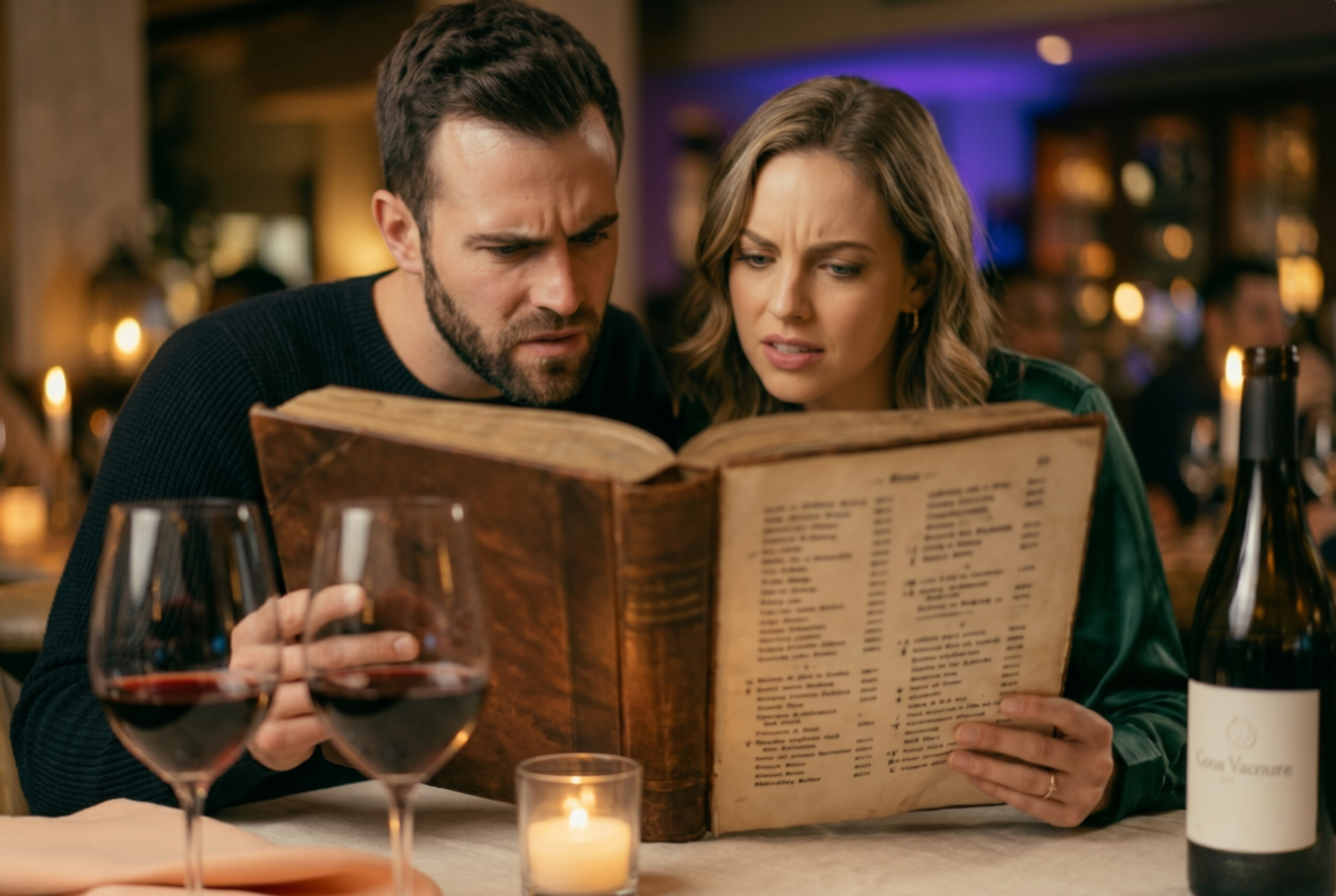
First the menu arrives, then the wine list: heavier, longer, often written in a language all its own. And that is where, for many people, the evening wobbles for a few seconds. Choosing wine at the table looks like a trivial gesture. It isn’t. In fact it is one of the most studied micro-decisions in consumer-behaviour research — and the findings, once you read them, are surprising. We pulled together a handful of Italian and international studies to understand what really happens, in the mind of the person drinking, between the starter and the choice of bottle.
The most stressful moment of dinner
Let’s start with something counter-intuitive: ordering wine at a restaurant is experienced as more stressful than buying it in a wine shop or supermarket. Several works document this, from Lacey, Bruwer and Li (2009) through to the studies by Jaeger and colleagues: for the same product, context changes everything. At a restaurant you choose in public, under time pressure, often on behalf of other guests, and without being able to taste first.
Researchers call this perceived risk, and break it into three dimensions: financial (in a restaurant wine costs on average more than three times the retail price — de Meza and Pathania measured this in 2021), social (fear of being judged by those at the table and by the staff) and functional-psychological (what if the bottle is wrong, or doesn’t work with the dish?). Curiously, it is precisely in high-end dining that perceived risk tends to fall: the venue’s reputation and the presence of competent staff are reassuring. They are, in effect, guarantees.
The shortcuts we use
To reduce that risk, we rely on strategies that are almost always unconscious. The three most common: past experience (a label or grape variety already tried), the reputation of the venue and — above all — asking. Bruwer, Fong and Saliba (2013) showed that searching for information is by far the most used risk-reduction strategy, across nearly all consumption occasions. When no one guides us, we fall back on memory: we try to recall what we had drunk and liked. It is a defensive behaviour, not an exploratory one.
The list as a labyrinth
In Italy, restaurant wine is an economic pillar, not a detail. The first Fipe-UIV Observatory presented at Vinitaly in April 2026 estimates wine turnover in food service at around 12 billion euros a year, over 21% of the average bill. A wine list is present in 3 out of 4 restaurants and in half of pizzeria-restaurants, for a total of more than 4.1 million entries. Yet it is often a static tool: in 54% of cases it is updated less than once a year.
And the way the list is organised changes our behaviour. The classic layout groups wines by origin (country, region). An alternative is to group them by style — “fresh whites”, “full-bodied reds” — a language closer to those who don’t know the appellations. Staub and Siegrist (2022) tested the two logics: ordering by style does not automatically reduce perceived difficulty, and in fact lengthens choice times, yet many customers prefer it because it speaks their language. The order in which wines appear also matters: research shows that the sequence on the list influences which wine is chosen, how quickly, with how much effort and at what average price.
Price as a compass (and the myth of the second-cheapest)
Price is, together with provenance, one of the two factors that weigh most in the choice. And around price one of the most widespread beliefs has grown: “order the second-cheapest wine”, so as not to look stingy without getting fleeced. The trouble is that it is, precisely, a belief.
De Meza (London School of Economics) and Pathania (University of Sussex) analysed more than 6,300 bottles in 249 London restaurants. The result: the second-cheapest wine is not the rip-off it’s said to be. Its percentage markup is lower than that of the four bottles immediately above it; the highest margin, if anything, nests around the middle of the list. That is exactly where we instinctively tend to look: decision research calls our tendency to avoid extremes and choose the middle option, perceived as reasonable, the “compromise effect” (Simonson and Tversky, 1992). Restaurateurs know it.
What the eye looks at
A recent study by Díaz-Armas and colleagues (2026) used eye-tracking technology to follow the gaze of those choosing from a list. When the names of the wineries (the brands) are clearly visible, the decision is faster and shifts towards the medium-high price bands. When brands are missing, attention migrates to other quality cues — designation of origin and grape variety — and price sensitivity increases, pushing towards the extremes (both cheap and expensive bottles). In other words: what is printed on the page literally guides our eyes, and with them the choice.
Words carry weight
Descriptions are not decoration. In a classic study from the Cornell Food and Brand Lab, Wansink, Painter and van Ittersum (2001) showed that adding a description to a menu item increased that dish’s sales by 27%, and led customers to judge it of higher quality and to return more willingly. Curiously, though: they were not willing to pay more for it, because the price alongside acts as an anchor. The same applies to pairings: in a field experiment, suggesting a food-and-wine match grew sales of the indicated wine by about 44.5% (Wansink and colleagues, 2006). A line of description, or a “great with dish X”, counts for more than a medal.
The human factor
The most powerful lever, however, remains a person. Dewald (2008), interviewing 250 high-end restaurants, found that customers ask for advice about 38% of the time, and that sommeliers offer it spontaneously 42% of the time. Where there is a dedicated sommelier, more tables order wine (76% versus 70%) and the average bill is higher. A 2025 study based on real sales data quantifies the effect: the presence of a sommelier increases wine sales by about 11.5%, without raising the price of the chosen bottle. Good advice is, simply, the most effective antidote to the anxiety we mentioned at the start.
The invisible context
Finally, we are influenced by things we don’t even notice. In a now-famous experiment, North, Hargreaves and McKendrick (1997, published in Nature) played French and German music on alternating days in a store, next to a shelf of wines from the two countries. With French music, French wines outsold German ones five to one; with German music, the effect reversed. When questioned, almost all the customers swore the music had had no influence. And again: 2025 sales data show that those who arrive later in the evening tend to order more expensive bottles. The frame around the choice shapes the choice.
So, who really chooses?
The thread tying all these studies together is just one: choosing wine is not a rational act of comparing labels. It is an emotional, social, context-dependent moment, full of small frictions and silent anxieties. And research says something precise to whoever runs a venue: the best thing is not a longer list, but a list that reduces friction and offers guidance. A clear organisation, two honest words of description, a pairing suggestion, someone (or something) that can answer “and with this dish?”.
There is also a forward-looking data point: according to the UIV-Vinitaly Observatory, it is precisely Generation Z that is most willing to be guided when choosing out of home. They don’t want less help: they want more of it, as long as it comes in the right way.
That is exactly the problem we are working on. Wine, for us, is a conversation — and choosing it should feel like one too. See you between one bottle and the next.
Ambrosia Team
Sources
- Lacey, S., Bruwer, J. & Li, E. (2009). The role of perceived risk in wine purchase decisions in restaurants. International Journal of Wine Business Research, 21(2), 99–117.
- Bruwer, J., Fong, M. & Saliba, A. (2013). Perceived risk, risk-reduction strategies (RRS) and consumption occasions. Asia Pacific Journal of Marketing and Logistics, 25(3).
- Staub, C. & Siegrist, M. (2022). Rethinking the wine list: restaurant customers’ preference for listing wines according to wine style. International Journal of Wine Business Research, 34(3) (ETH Zürich).
- de Meza, D. & Pathania, V. (2021). Is the second-cheapest wine a rip-off? Economics Letters / AAWE Working Paper No. 264 (London School of Economics & University of Sussex).
- Simonson, I. & Tversky, A. (1992). Choice in Context: Tradeoff Contrast and Extremeness Aversion. Journal of Marketing Research.
- Díaz-Armas, R., Campo, S., Fernández-Martín, A. & Gutiérrez-Taño, D. (2026). Designation of Origin, Brand or Price: What Factors Determine Wine Selection in a Restaurant? An Analysis Using Eye-Tracking. Cornell Hospitality Quarterly.
- Wansink, B., Painter, J. & van Ittersum, K. (2001). Descriptive Menu Labels’ Effect on Sales. Cornell Hotel and Restaurant Administration Quarterly.
- Wansink, B., Cordua, G., Blair, E., Payne, C. & Geiger, S. (2006). Wine promotions in restaurants. Cornell Hotel and Restaurant Administration Quarterly, 47(4).
- Dewald, B. (2008). The role of the sommeliers and their influence on US restaurant wine sales. International Journal of Wine Business Research, 20(2), 111–123.
- An empirical investigation of wine sales as a driver of financial performance in restaurants (2025). International Journal of Hospitality Management (real sales data).
- North, A. C., Hargreaves, D. J. & McKendrick, J. (1997). In-store music affects product choice. Nature, 390, 132; and (1999) The influence of in-store music on wine selections.
- Fipe-UIV “Wine & Food Service” Observatory in collaboration with Vinitaly (April 2026); UIV-Vinitaly consumer Observatory (March 2026).
